Replanting what was lost
Kellen never expected to lose his way so close to school.
One afternoon, the Grade 12 student went for a hike in the forest behind UWC ISAK Japan. He thought he knew the path, but suddenly something felt off. It wasn’t the presence of too many trees that confused him: it was the absence. He stumbled into a vast, empty clearing. No rustling. No birdsong. Just dirt and rocks. Where life once thrived, there was now silence.
Just a few weeks earlier, Kellen had walked through that same stretch of forest. He remembered how alive it had felt. Now it was a barren scar stretching farther than he could see.
That moment stayed with him.

From disorientation to determination
While most students might have seen the deforested land and simply moved on, Kellen stopped. He didn’t want to just feel sad about it: he wanted to do something. Rather than accept the silence, he asked: What could be done to bring it back?
This moment of disorientation became a moment of awareness, reflecting something his teachers had long recognized: Kellen’s ability to see systems, not just objects, and to approach problems by understanding their structure and rhythm. Whether in the classroom or in Outdoor Education leading group expeditions, he approached challenges with the calm precision of someone who listens before acting.
And that’s how the Miyawaki Forest Project began.
Planting hope one tree at a time
Kellen’s curiosity led him to an article in The New York Times titled “Can Tiny Forests Help Fight Climate Change? ” and from there, to the Miyawaki Method: a Japanese-developed approach to restoring biodiversity through dense native planting. Pioneered by botanist Akira Miyawaki, the method creates pocket forests that grow up to ten times faster than those established using traditional approaches, even in areas as small as three square meters.
In Grade 11, he launched the Pocket Forest CAS group on campus and attended a UN symposium on urban micro-forests in Yokohama. That experience helped him connect with environmental leaders and deepened his resolve.
Inspired by the approach and its origins here in Japan, Kellen decided to create his own pocket forest where nature had been stripped away. Many students might have been satisfied with just research. Kellen went further, translating theory into practice.
But he quickly learned that wanting to plant a forest and actually doing it are two very different things.

Navigating obstacles with quiet grit
Kellen reached out to city officials in Kaohsiung, Taiwan, and began the complex work of navigating bureaucratic processes. He started with cold emails to companies asking for support. Most didn’t even reply. He was just a teenager with a big idea. When early fundraising efforts were rejected repeatedly, it was discouraging, but he kept going.
Support came from unexpected places. His desire to restore biodiversity in an industrial area aligned with local religious temples, who offered donations. Local communities and organizations who saw sincerity and purpose in his plan began to rally behind the vision.
Finding a site meant more bureaucratic navigation. At one point, land was allocated and then taken back. Eventually, a small public plot was approved. That’s when Kellen met a professional tree planter who became his mentor, teaching him not just about soil restoration and native plants, but also about patience, resilience, and hope.


Building an ecosystem, building a legacy
The Miyawaki method isn’t just about planting trees: it’s about restoring biodiversity and cultivating a community that values nature and sustainability. It requires meticulous preparatory steps: assessing and enhancing soil quality, surveying natural vegetation species, and irrigation planning.
Under Kellen’s leadership, local volunteers gathered to plant 240 native saplings, creating Kaohsiung’s first Miyawaki Forest. His story was even picked up by the Commercial Times in Taiwan, making him realize how far the impact could reach.
Throughout the project, Kellen demonstrated a leadership style defined not by volume, but by composure. He remained steady and analytical in moments when plans faltered, approaching setbacks with quiet grit and refusing to let frustration overshadow progress. His observant nature allowed him to connect patterns others missed — between soil and community, between systems and solutions.

Leadership beyond titles
Kellen’s project isn’t a standalone success story. It’s an expression of how he embodies UWC ISAK Japan’s leadership philosophy: to take meaningful action in the face of uncertainty.
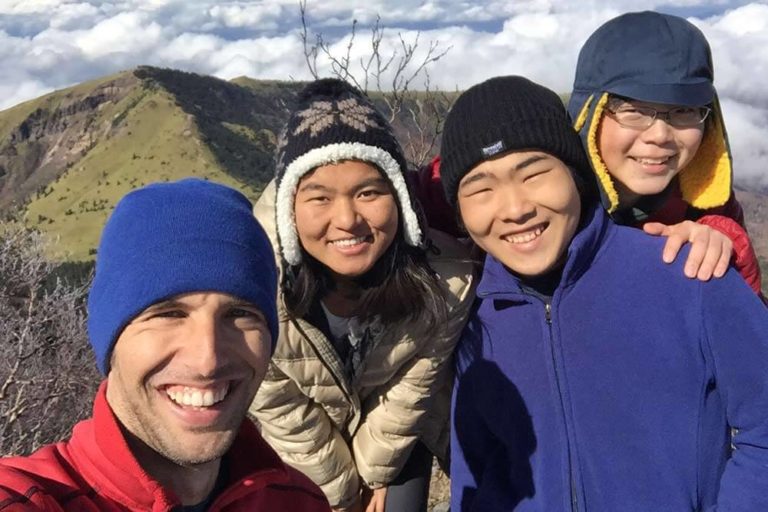
In classrooms, he brings the same depth of thought that he shows in the field. Discussions with him often expand into questions of ethics, sustainability, and what long-term responsibility looks like in practice. Outside the classroom, he serves as Residential Assistant of his boarding house, captain of the volleyball club, and Outdoor Education leader. On weekends, he’s often found in the mountains of Japan, guiding outdoor education trips that connect students with nature.
Throughout this journey, Kellen has had to constantly identify what is most important and needed — not just environmentally, but in his own growth. He’s had to take action in the face of discomfort more times than he can count. And that’s exactly what his education at UWC ISAK Japan has equipped him to do.
Here, leadership isn’t about holding a title. It’s about doing the hard thing because it’s the right thing. Even when it’s uncomfortable. Even when you’re unsure.


Growing roots in many directions
What started as a moment of getting lost in the forest became a turning point. As Kellen prepares for college, the forest he planted continues to grow: both as an ecosystem and as a legacy of student-led initiative.
For him, it was never about one event or one plot of land. It was about building frameworks for regeneration, both ecological and personal. His journey shows what happens when knowledge, reflection, and courage intersect. It’s a story that began with noticing absence and ended with creating presence.
Through this experience, Kellen realized that real change starts when we notice what’s needed and decide to take the first step. Even if it feels small. Even if we’re scared.
And for UWC ISAK Japan, it’s a reminder that the most lasting forms of leadership often start quietly, with one student choosing to look closer. In planting the Miyawaki forest, Kellen became a catalyst for positive change.
This isn’t the end of the story. It’s just the first forest.