
Our program is intentionally designed with flexibility. We believe the best experiences emerge when a team comes together, responds to who is in the room, and adapts to what will be most meaningful for all of us collectively.
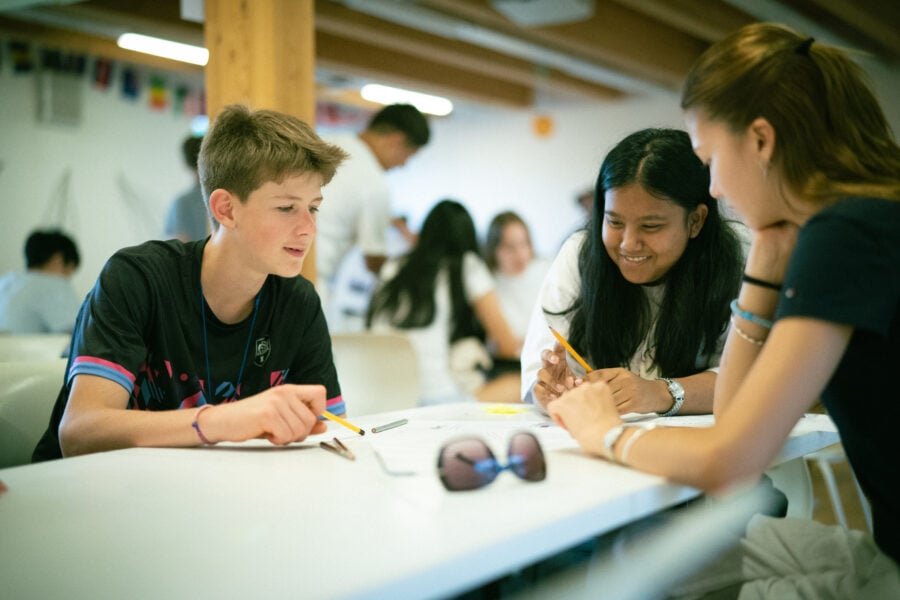
How can you shape this experience?
One of the best ways we have seen our students grow through the Summer School is by showing up and taking ownership.
Ways you can do that this Summer School are
- Facilitate our morning Check ins
- Share your stories in Community Stories
You can choose to share stories from your culture, life back at home or things you are passionate about. This will be your space to share your story with the community. - Share your culture on UWC International Day
Bring your traditional dress to wear, share a presentation about your culture and get the community involved in a cultural celebration (singing/dancing/rituals) - Run extra curricular activities (ECA)
Throughout the program we will have designated spaces for ECAs. While they are always run by the team, students are encouraged to create and run their own. - Organise other activities during the Summer School for the whole community.
Activities such as – Karaoke, Star gazing, nature walks, sports, conversation cafes, etc.
Classes for Summer School 2026
The story of storytelling
Faculty: Cagn Cochrane
In this course, we will ask one of the oldest and most alive questions there is: what is a story, and why does it matter? Together we will explore how stories shape the way we see ourselves, how they connect us to others, and how they hold entire worlds together. We will look at where stories come from, how they work, and what happens when they change. Along the way, we’ll examine our own personal narratives, encounter stories from the diverse cultures present in our community, and ask what the grand stories that are in media, history, and myth around us tell us about the world we live in.
You will be active participants in this course because stories live in the body before they live in the mind. So we will learn by doing: through storytelling games, hands-on making, deep listening circles, short sharp readings chosen to surprise and stick, and a final project in which students create their own story told across multiple forms of expression. Such as a comic, a podcast, a poem, a short film, or something else entirely.
By the end of this course, students will have sharpened their ability to listen, to read between the lines, and to tell their own story with more intention and more courage and they may find that the story they tell about themselves has quietly begun to change.
Exploring everyday life: Culture, Power and Inequity
Faculty: Manuela
How do we make sense of the world? What do we take for granted? What is culture? What are social systems? What makes something “normal”? In this course, we will put on our “anthropological hats” to explore these big questions through interactive games, group discussions, journaling, and real-world observation. Together, we’ll examine everyday life through familiar aspects like food, clothing, language, and space to learn about how culture is a learned, shared, and shaped experience. Students will also explore how societies are organized through institutions such as family, religion, education, media, and the economy, and how social categories like race, gender, nationality, and class shape people’s experiences of the world. By the end of this course, students will develop strong observational and critical thinking skills, challenge their assumptions about what is “normal,” and learn how to identify and understand social issues within their own communities.
Experiments in optics
Faculty: Alex Pernisova
Have you ever paused to look at how light passes through a moving train? Or sometimes it splits into a rainbow if you drink water from a glass (under a certain angle)! And have you ever moved light reflection through your classroom with the face of your watch?
In this course we will investigate the behaviour of light through experiments, as done in optics – the field of physics that studies light.
We will look through the lens of science and the lens of our immediate experience. The first lens touches on our modern-world experiences with math classes, pixel resolution in displays and fast internet cables. The second lens relates to everyday joys of trying to jump into someone’s shadow, admiring colours on an oil-spill and all the ways we can break light into colours.
The bridge between these two perspectives offers us an important question, namely: How have we (as humanity) arrived at modern science’s description of light from our shared personal experience? We will explore optics through hands-on experiments, through which we can observe the behaviour of light and understand how scientific discoveries were made.
Circular design against inequality
Faculty: Mile Krstev
In this class concepts like design thinking , circularity , and social (in)equality will be explored. The goal of the class is to learn how to use circular design as a tool to come up with solutions to problems stemming from existing disparities in wealth and environmental degradation. We will talk (and play a game) about natural resources, inequality, recycling and reusing as part of the process. For the project component, we will explore how design thinking and circularity can be used in coming up with solutions to both local and global issues.
Pre work for Summer School 2026
As you are getting ready for Summer School 2026 our team has requested some pre work which will help you be prepared.
You can complete this pre work at your own time, and where necessary bring a printout or email it to us. This pre work will then we used in your classes to deepen your learning and experience
For some of the courses we have also updated a vocabulary list of words that you can familiarize yourself with.
Circular design against inequality
For an activity related to the “Circular design against inequality” course, we would like you to bring a piece of clothing that you would be willing to exchange with or give away to someone. This can be anything from a t-shirt or dress to pants or a scarf or a hat! Any kind of textile. Think of what’s in your wardrobe that you haven’t worn in a while. Or it can be something that no longer fits you. Or an item that carries an interesting story that you would like to share with someone. This can be your chance to give that clothing item a second life. What you should definitely not do is to buy a new piece of clothing for this purpose! It should be something you already have. Think of what we will do as a second-hand boutique at UWC ISAK!
The second task for you will be to investigate about the journey of this piece of clothing before it made it into your wardrobe. Use no more than one A4 sheet of paper to tell the story of your piece of clothing. You can draw, write, attach photos, or use anything else that would help you present your findings. Think of the following questions: Where was it made? How was it made? How and how far was it transported? What is it made of? Where did those materials come from? Why did you buy it or receive it? Does it carry any special meaning for you? Why are you now deciding to give it away?
We will then attach your story to the clothing item in the second-hand boutique where others will be able to take it if they like it (and you will be able to take something else you like that the others have left).
Experiments in optics (Click the link)
Pre work
Vocabulary list
Exploring everyday life: Culture, Power and Inequity (Click the link)
Pre work
Vocabulary list
Workshop
Please bring a local print publication from your home country. This could be a newspaper, a magazine, a flyer, a restaurant pamphlet, or anything similar.
A few important notes:
• Please don’t spend any money on this. We’re looking for something that’s already lying around your home or a community space that no one needs anymore
• Make sure it’s not precious to anyone. These publications will become shared material for a workshop: they’ll be cut up and used, by you and by other students. Please don’t bring anything you would want to keep intact.
• Publications with images are preferred over publications that only contain text!
International Day
One of the most beautiful parts about this Summer School and UWC ISAK is our diversity. The stories, culture and practices each one of us brings. And we would love to celebrate this diversity.
On the 26th of July we will have our International Day celebration.
As a student, you can opt to share a presentation, share a dance, a song or any practice that represents you and your culture.
While this is not mandatory, we would love to hear from your.
If none of these excite you, you are also welcome to just wear a cultural outfit and share that experience with everyone.
